
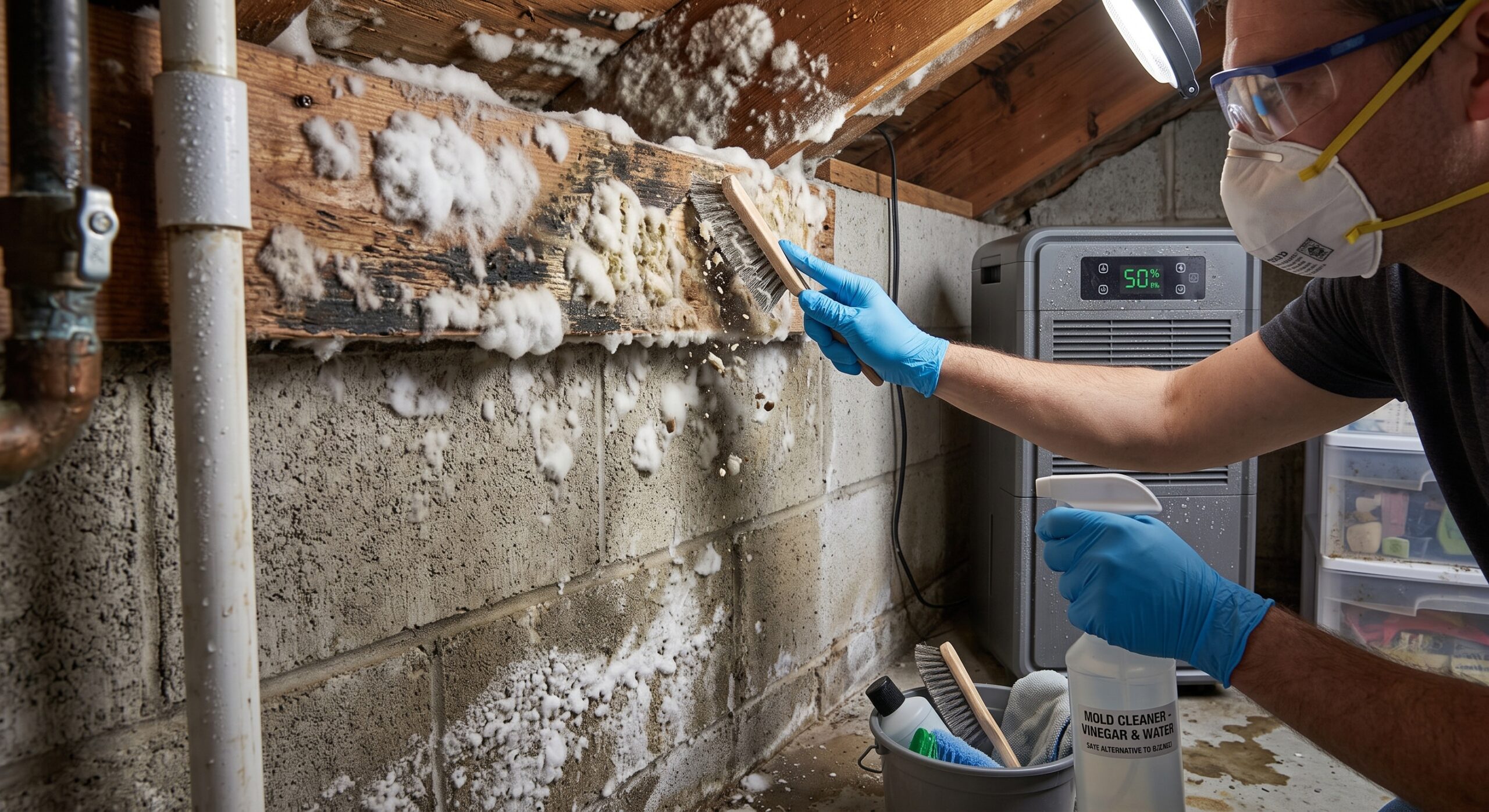
White Mold in the Basement: What It Is and How to Remove It
You go down to the basement and notice white, fuzzy or powdery patches on the wooden joists, the concrete walls or a box you stored months ago. Is it mold? Is it dangerous? And how do you get rid of it for good?
Quick answer: white mold is common in basements because they’re cool, damp and poorly ventilated. It usually appears as fuzzy or cotton-like patches on wood, drywall, cardboard and fabric. Before treating it, make sure it isn’t efflorescence, a harmless mineral deposit that looks similar on concrete. If it is mold, you can usually clean small areas yourself, but it will keep coming back unless you lower the basement’s humidity.
What white mold is
“White mold” isn’t a single species. It’s a name for several common molds that look white or light gray, especially in their early stages. In basements, the usual culprits are Penicillium, Aspergillus, Mucor, Chaetomium and Trichoderma. Many of them turn green, gray or black as they grow, so white mold is often simply young mold.
It tends to look fuzzy, cottony or powdery, and it often grows in spots or streaks that spread along the grain of wood.
Why basements get white mold
- High humidity. Basements are below ground, so moisture from the soil seeps through concrete walls and floors. Humidity often stays above 60%, which is ideal for mold.
- Condensation. Warm, humid summer air hits cool basement walls and pipes and turns into water.
- Poor ventilation. Little air movement means damp air stays trapped.
- Plenty of food. Wooden joists, subfloors, drywall, cardboard boxes and old furniture are all things mold can feed on.
- Leaks and floods. Cracks in the foundation, plumbing leaks or past flooding give mold the water it needs.
Where you’ll usually find it
On floor joists and the underside of the subfloor, on wooden stairs and shelves, on the paper side of drywall, on stored cardboard boxes, fabrics and furniture, and around windows, pipes and the water heater.
White mold or efflorescence?
Efflorescence is the most common thing mistaken for white mold in basements. It’s a harmless deposit of salt crystals left behind when water moves through concrete or brick and evaporates. It doesn’t cause health problems, but it does tell you water is getting through your walls.
| White mold | Efflorescence | |
|---|---|---|
| Where it grows | Wood, drywall, cardboard, fabric, and sometimes dusty concrete | Only on concrete, brick, stone or block |
| Texture | Fuzzy, cottony or slimy | Crystalline, chalky, powdery |
| Water test | Doesn’t dissolve | Dissolves when sprayed with water |
| Touch test | Smears or feels soft | Crumbles into a dry powder |
| Smell | Musty, earthy | No smell |
| Color over time | Can turn green, gray or black | Stays white |
Quick test: spray a little water on the white patch. If it dissolves within a minute or two, it’s efflorescence. If it stays, and especially if it’s on wood or has a musty smell, treat it as mold.
Is white mold dangerous?
White mold is not safer than black or green mold. Color doesn’t tell you how risky a mold is. For most healthy people, a small patch causes mild or no symptoms, but it can trigger a stuffy nose, sneezing, coughing or itchy eyes, especially in people with allergies or asthma.
In a basement, there are two extra concerns:
- The air travels. Air from the basement rises into the rest of the house, so spores can reach living areas and bedrooms.
- It can damage your home. Some molds slowly weaken wood when it stays wet for a long time. White mold on joists or the subfloor is a sign to act before the wood is damaged.
If anyone at home has asthma, allergies or a weakened immune system, or if symptoms improve when they leave the house, talk to a doctor. This article is general information, not medical advice.
How to remove white mold from your basement
If the affected area is smaller than about 10 square feet and the material isn’t soaked through, you can usually handle it yourself.
What you’ll need: an N95 mask, rubber gloves, safety goggles, a spray bottle, a stiff brush, household detergent or a mold cleaner, a HEPA vacuum (if you have one), clean rags and trash bags.
- Protect yourself. Put on the mask, gloves and goggles before you touch the mold.
- Ventilate the basement. Open windows if possible and use a fan pointing outside. Keep the door to the rest of the house closed.
- Lightly mist the area. Spraying a little water keeps spores from flying into the air while you work.
- Scrub the surface. Use a brush with warm water and detergent, or a mold cleaner. On wood, scrub along the grain.
- Deal with wood carefully. If mold remains in the wood after scrubbing, lightly sand the surface (with a HEPA vacuum nearby) or apply a mold-resistant primer once it’s dry.
- Throw away what you can’t clean. Moldy cardboard, old fabrics, carpet and soaked drywall are usually better bagged and discarded.
- Dry everything completely. Use fans and a dehumidifier for at least 24 to 48 hours.
- Watch the area. If the mold comes back within a few weeks, the moisture problem hasn’t been solved yet.
We don’t recommend bleach on wood or drywall: it doesn’t reach the mold inside porous materials, and it adds more moisture.
How to keep white mold from coming back
- Run a dehumidifier. This is the single most effective step. Keep basement humidity between 30% and 50%, and check it with a cheap hygrometer.
- Improve air flow. Leave interior doors open, use a fan, and don’t pack storage tightly against walls.
- Store things off the floor. Use plastic bins instead of cardboard boxes, and metal or plastic shelves instead of wood.
- Insulate cold pipes. Foam pipe sleeves stop condensation from dripping onto wood and walls.
- Keep water away from the foundation. Clean gutters, extend downspouts at least 4 to 6 feet from the house, and make sure the ground slopes away.
- Seal cracks. Fill small cracks in the foundation and consider a waterproof coating on the inside of basement walls.
When to call a professional
Call a mold remediation company if the mold covers more than about 10 square feet, keeps coming back after cleaning, has grown into soft or damaged wood, appeared after a flood or sewage backup, or if someone at home has health concerns. If water is regularly getting into your basement, a waterproofing contractor can find and fix the source.
Frequently asked questions
Is white mold on basement joists a serious problem?
It’s common and usually not an emergency, but it shouldn’t be ignored. It means the basement is too humid, and if the wood stays wet long enough, it can start to weaken. Clean it and lower the humidity.
Can I just paint over white mold?
No. Paint doesn’t kill mold, and it will grow back through or under the paint. Clean and dry the surface first, and then use a mold-resistant primer if you want extra protection.
Does vinegar kill white mold?
White vinegar can help on some surfaces, but it isn’t a complete fix on its own. Scrubbing, drying and lowering humidity are what really solve the problem.
Why does white mold keep coming back in my basement?
Because the basement is still too damp. Until humidity stays below 50% and any leaks are fixed, mold will keep returning after every cleaning.
What size dehumidifier do I need for a basement?
It depends on the size of the basement and how damp it is. As a rough guide, a 35 to 50-pint model works for most average basements, and very damp or large ones may need a bigger unit.
Sources
- U.S. Environmental Protection Agency (EPA): A Brief Guide to Mold, Moisture, and Your Home
- Centers for Disease Control and Prevention (CDC): Mold
Last reviewed: October 2026. This article is for general information and is not medical, legal or professional advice.





Hi, this is a comment.
To get started with moderating, editing, and deleting comments, please visit the Comments screen in the dashboard.
Commenter avatars come from Gravatar.