
What Size Dehumidifier Do I Need? Sizing Guide
Buying a dehumidifier that’s too small is one of the most common mistakes. It runs all day, uses a lot of electricity and still can’t keep humidity down. Too big, and you’ve paid more than you needed to. The right size depends on two things: how big the space is, and how damp it is.
Quick answer: measure the square footage of the space and judge how damp it is, then use the chart below. As a rough guide under the current DOE rating: a small, slightly damp room needs about 20 pints per day; an average basement needs around 35 pints; and a large or very damp basement needs about 50 pints or more. When in doubt, size up. A slightly larger unit works less hard and reaches your target humidity faster.
What “pints per day” means
Dehumidifiers are sized by how many pints of water they can remove from the air in 24 hours under standard test conditions. A 35-pint dehumidifier can pull about 35 pints (roughly 4.4 gallons) of water out of the air in a day under those conditions.
The 2019 rating change (important)
In 2019, the U.S. Department of Energy changed how dehumidifiers are tested, from warm conditions (80°F) to cooler, more realistic basement conditions (65°F). Cooler air holds less moisture, so the same machine now gets a lower pint rating than before.
| Older rating (before 2019) | Approximate current rating |
|---|---|
| 30 pints | about 20 pints |
| 50 pints | about 35 pints |
| 70 pints | about 50 pints |
When you compare models or read older sizing charts online, make sure you’re comparing the same rating system. Most new models sold today use the current standard. The chart in this article uses the current rating.
How damp is your space?
| Condition | What you notice |
|---|---|
| Moderately damp | Feels damp or musty only in humid weather |
| Very damp | Always feels damp and smells musty; some condensation |
| Wet | Damp walls or floors, frequent condensation, visible mold spots |
| Extremely wet | Water seeping in, standing water, wet floors or walls |
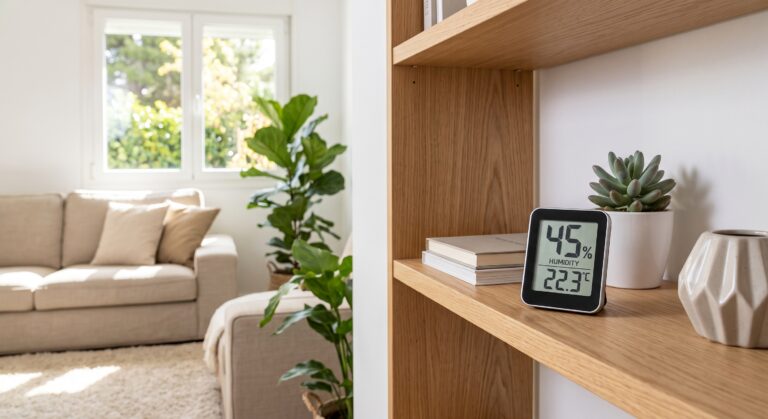
If you have a hygrometer, a space that regularly sits at 60% to 70% is roughly “very damp,” and above 70% is “wet.” If water is actively seeping in, fix that first: a dehumidifier can’t keep up with a leak.
Dehumidifier size chart
Pints per day, current DOE rating. This is an approximate guide based on common manufacturer recommendations; always check the maker’s own chart for the model you choose.
| Space (sq ft) | Moderately damp | Very damp | Wet | Extremely wet |
|---|---|---|---|---|
| Up to 500 | 20 | 20 | 20–22 | 22–35 |
| 500–1,000 | 20 | 20–22 | 35 | 35 |
| 1,000–1,500 | 20–22 | 35 | 35 | 50 |
| 1,500–2,000 | 35 | 35 | 50 | 50 |
| 2,000–2,500 | 35 | 50 | 50 | 50+ or heavy-duty |
| Over 2,500 | 50 | 50+ | Heavy-duty or two units | Heavy-duty or two units |
Most portable dehumidifiers sold today come in a few common sizes: about 20–22 pints (small), 35 pints (medium) and 50 pints (large). Heavy-duty basement and crawl space units go higher.
Factors that mean you should size up
Choose the next size up if any of these apply:
- You live in a humid climate (for example, the Southeast or Gulf Coast).
- The basement is cool (below about 65°F), where dehumidifiers work less efficiently.
- There’s a washer or dryer in the space.
- Several people use the space, or it has many doors and windows that get opened.
- The basement is open to other rooms or the stairs have no door.
- The space has visible mold or a strong musty smell.
How to choose: step by step
- Measure the space. Multiply length by width for each area and add them up. For an open basement, include the whole area the dehumidifier needs to cover.
- Judge the dampness using the table above, or a hygrometer reading.
- Find the size in the chart.
- Size up if any of the factors above apply.
- Check drainage options. Large units fill buckets fast, so choose a hose or pump for basements.
- Check it works. After a week, your hygrometer should show 45% to 50%. If it doesn’t, the unit may be too small, or water is getting in from outside.
Too small vs. too big
| Too small | Too big |
|---|---|
| Runs nonstop and still can’t reach your target | Reaches the target quickly and cycles off |
| Higher electricity use for poor results | Costs more to buy, and is bulkier and heavier |
| Coils can wear out faster | Little real downside if it has a humidistat |
| Mold risk stays high | Humidity stays under control |
In practice, a slightly oversized dehumidifier with a built-in humidistat is a much safer choice than an undersized one.
Frequently asked questions
Is a 35-pint dehumidifier enough for a basement?
For many average basements up to about 1,500 to 2,000 square feet that are moderately to very damp, yes. Wet or larger basements usually need a 50-pint unit.
35 vs. 50 pint: which should I buy?
If you’re between sizes, or your basement is cool, humid or has a laundry area, choose 50 pints. The price difference is usually small compared with the benefit.
Can one dehumidifier cover the whole house?
A portable unit usually covers one open area. For a whole house, consider a whole-house dehumidifier connected to the HVAC system, or one unit per problem area.
Why does my old 70-pint dehumidifier say 50 pints on the new model?
Because of the 2019 DOE testing change. The new rating reflects cooler test conditions, not a weaker machine.
Is it better to use two smaller units or one large one?
One large unit is usually more efficient for one open space. Two units make sense for separate rooms or a basement split into sections.
Sources
- U.S. Environmental Protection Agency (EPA): A Brief Guide to Mold, Moisture, and Your Home
- Centers for Disease Control and Prevention (CDC): Mold
Last reviewed: October 2026. This article is for general information and is not medical, legal or professional advice.