Does Hydrogen Peroxide Kill Mold?
If you want to clean mold without the harsh fumes of bleach, hydrogen peroxide is one of the best options you probably already have at home. It’s the same brown bottle used as a mild antiseptic, and it works well on many household surfaces.
Quick answer: yes, hydrogen peroxide kills many common household molds on surfaces. The standard 3% solution sold in drugstores works well on tiles, grout, tubs, sinks, countertops and many hard surfaces. Spray it on undiluted, leave it for about 10 minutes, scrub and wipe. It has no harsh fumes and breaks down into water and oxygen, but it can lighten some colors and fabrics, so test it first. Like any cleaner, it won’t fix mold growing deep inside drywall or carpet.
How hydrogen peroxide works on mold
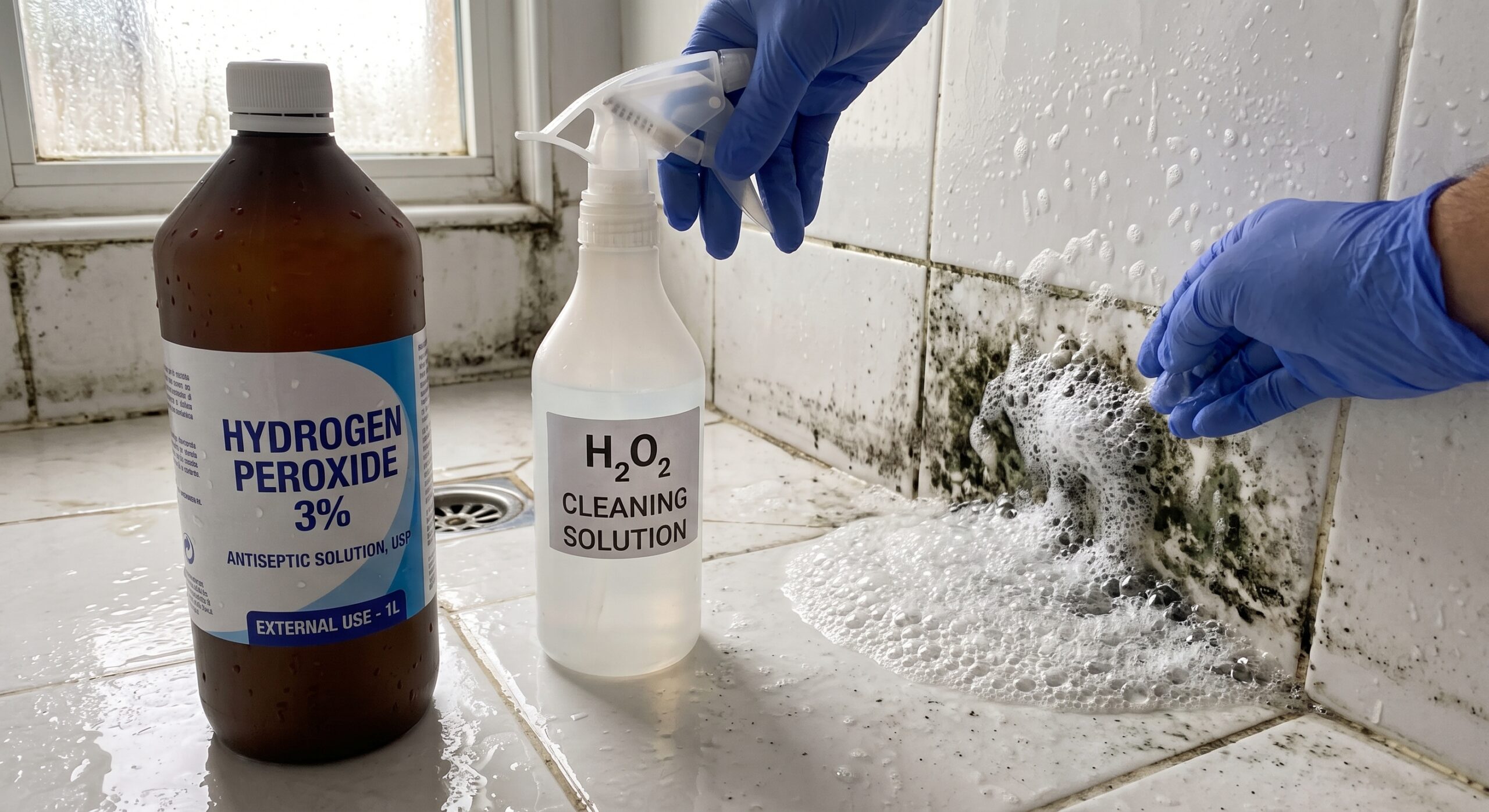
Hydrogen peroxide (H₂O₂) is an oxidizer. When it touches mold, it breaks down the mold’s cells and releases oxygen, which is why you often see it fizz. That fizzing also helps lift mold out of small pores in grout and textured surfaces. Afterward, it breaks down into plain water and oxygen, leaving no toxic residue.
Pros
- Kills many common household molds on surfaces
- No strong fumes, unlike bleach
- Breaks down into water and oxygen
- Cheap and easy to find
- Soaks into grout and semi-porous surfaces a little better than bleach
- Also helps lighten mold stains
Cons
- Can bleach or lighten colored fabrics, carpets and some painted surfaces
- Works more slowly than bleach on heavy stains
- Loses strength once opened or exposed to light, so old bottles may not work well
- Doesn’t fix mold inside drywall, carpet padding or insulation
Where to use it
| Surface | Safe to use? |
|---|---|
| Ceramic tile, porcelain, tubs, sinks | ✅ Yes |
| Grout | ✅ Yes, one of the best uses |
| Glass and mirrors | ✅ Yes |
| Plastic, vinyl, laminate | ✅ Yes |
| Sealed countertops | ✅ Yes (test first on stone) |
| Painted walls | ⚠️ Test a hidden spot first |
| Unfinished wood | ⚠️ Can lighten it; test first |
| Colored fabrics and carpets | ⚠️ Can bleach colors |
| Natural stone (marble) | ⚠️ Use a stone-safe cleaner instead |
| Moldy drywall, insulation | ❌ Replace the material |
How to use hydrogen peroxide on mold
What you’ll need: 3% hydrogen peroxide, a dark or opaque spray bottle (light weakens it), gloves, goggles, an N95 mask for larger spots, a scrub brush or old toothbrush, and a clean cloth.
- Protect yourself with gloves and goggles, and open a window.
- Pour 3% hydrogen peroxide into a spray bottle, undiluted. You can also spray directly from the bottle if it has a spray top.
- Test a hidden spot on colored or painted surfaces.
- Spray the moldy area until it’s fully covered and wet.
- Leave it for 10 minutes. You may see it fizz.
- Scrub with a brush to remove the mold and any stains.
- Wipe clean with a damp cloth.
- Dry the area completely.
- Repeat if needed for stubborn stains.
Tip for grout: make a paste of baking soda and hydrogen peroxide, spread it on the grout, leave it for 10 to 15 minutes, then scrub and rinse.
Safety tips
- Use the 3% household strength. Higher concentrations (like 35% “food grade”) can burn skin and eyes and aren’t needed.
- Don’t mix hydrogen peroxide with vinegar in the same container; together they form peracetic acid, which is corrosive and irritating.
- Don’t mix it with bleach or other cleaners.
- Store it in its original dark bottle, away from light and heat.
Hydrogen peroxide vs. other mold cleaners
| Hydrogen peroxide (3%) | White vinegar | Bleach | |
|---|---|---|---|
| Kills surface mold | Yes | Yes | Yes |
| Works on grout | Very well | Well | Surface only |
| Removes stains | Well | Somewhat | Very well |
| Fumes | None | Mild smell | Strong |
| Time to work | ~10 minutes | ~1 hour | ~10 minutes |
| Risk to colors | Can lighten | Low | Bleaches |
| Leaves residue | No (water and oxygen) | Smell fades | Can leave residue |
For most bathroom and kitchen mold, hydrogen peroxide is a great middle ground: effective, fume-free and easy to use.
Frequently asked questions
Does hydrogen peroxide kill black mold?
It kills many common dark-colored household molds on surfaces. For large areas or mold inside walls, you’ll need professional removal.
Should I dilute hydrogen peroxide for mold?
No. Use the standard 3% solution straight from the bottle.
Is hydrogen peroxide better than bleach for mold?
For many household jobs, yes. It has no harsh fumes, works well on grout and breaks down into water and oxygen. Bleach is faster at removing heavy stains on hard surfaces.
Can I use hydrogen peroxide on wood?
Yes, with care. It can lighten the wood color, so test a hidden spot first and dry the wood well afterward.
How do I know if my hydrogen peroxide still works?
Pour a little on a sink drain or a cut potato. If it fizzes, it’s still active. If not, buy a new bottle.
Sources
- U.S. Environmental Protection Agency (EPA): A Brief Guide to Mold, Moisture, and Your Home
- Centers for Disease Control and Prevention (CDC): Mold
Last reviewed: October 2026. This article is for general information and is not medical, legal or professional advice.