How to Improve Bathroom Ventilation
Poor ventilation is the main reason bathrooms get mold. Every hot shower releases a lot of moisture, and if it isn’t removed quickly, it settles on the ceiling, walls, grout and caulk, where mold is happy to grow.
Quick answer: to improve bathroom ventilation, run an exhaust fan during every shower and for 20 to 30 minutes after, make sure the fan is strong enough (at least 1 CFM per square foot of floor area, with a minimum of 50 CFM) and vents outside, not into the attic. Add a timer or a humidity-sensing switch so it runs long enough, keep the fan clean, and leave a gap under the door for fresh air. If your bathroom has no fan, installing one is the single best upgrade you can make.
Signs your bathroom isn’t ventilated well enough
- The mirror stays fogged for more than 10 to 15 minutes after a shower
- Walls or ceiling feel damp, or water drips from the ceiling
- Black or pink spots keep coming back on grout, caulk or the ceiling
- Peeling paint or bubbling wallpaper
- A musty smell in the bathroom
- Towels never fully dry
- Warped wooden cabinets or door frames
How to test your exhaust fan
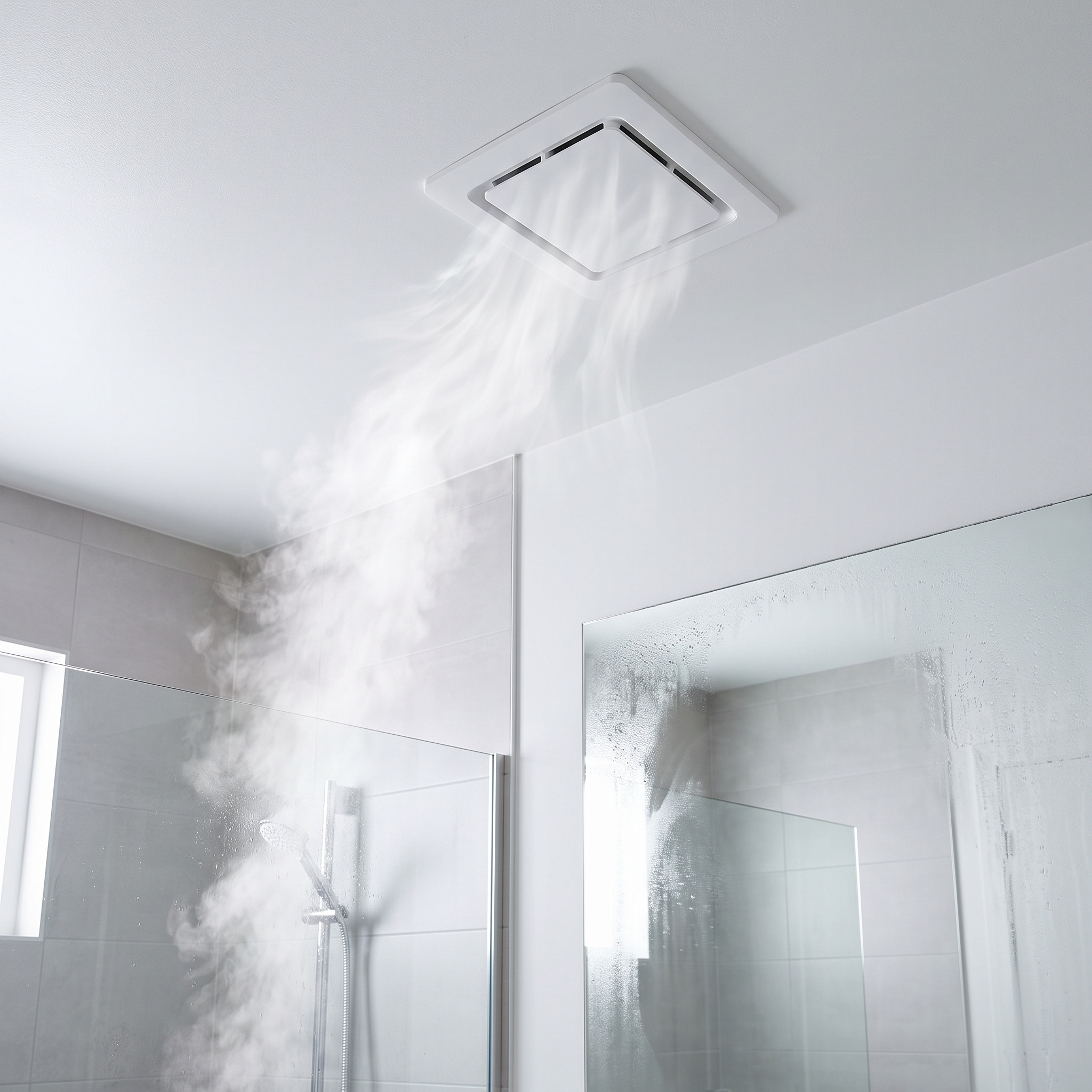
- The toilet paper test. Turn on the fan and hold a single square of toilet paper just below the grille. If the fan holds it firmly against the cover, it’s pulling air well. If the paper barely moves or falls, the fan is too weak, dirty or the duct is blocked.
- Check where it vents. Go into the attic (or look at the outside wall or roof) and follow the duct. It should end at a vent cap outside, not in the attic space or just near a soffit vent.
- Check the outside flap. With the fan on, the vent cap’s damper outside should open. If it’s stuck or blocked by a nest or debris, air can’t escape.
- Check the label. Remove the grille and look for the fan’s CFM rating on the motor housing. Many older fans are only 50 CFM or less, and may move much less air in practice if the duct is long or crushed.
- Time the mirror. After a typical shower with the fan on, the mirror should clear within about 10 to 15 minutes.
Easy improvements (no new fan needed)
- Run the fan longer. Turn it on when you start the shower and leave it running for 20 to 30 minutes afterward.
- Add a timer switch. It replaces your regular switch and turns the fan off automatically, so you don’t forget.
- Clean the fan. Turn off the power, remove the grille, wash it, and vacuum dust from the blades and housing. Do it every few months.
- Let fresh air in. The fan needs replacement air. Leave the door slightly open after showering, or make sure there’s a gap of about 3/4 inch under the door.
- Open the window after showering, if you have one and it’s not too cold or humid outside.
- Squeegee walls and glass after showering to remove water before it evaporates into the air.
- Hang towels to dry spread out, not bunched up.
Upgrading or installing an exhaust fan
Choose the right size (CFM)
CFM means cubic feet per minute, the amount of air the fan moves.
- Bathrooms up to 100 square feet: at least 1 CFM per square foot of floor area, with a minimum of 50 CFM. A 6 × 8 ft bathroom (48 sq ft) needs at least 50 CFM; an 8 × 10 ft bathroom (80 sq ft) needs at least 80 CFM.
- Bathrooms over 100 square feet: a common guideline is to add up the fixtures: about 50 CFM each for the toilet, shower and bathtub, and 100 CFM for a jetted tub.
- Size up if the duct is long, has several bends, or your ceiling is higher than 8 feet.
Choose a quiet fan
Noise is measured in sones. A fan rated around 1.0 sone or lower is quiet; old fans are often 3 to 4 sones, which is why people turn them off early.
Useful features
- Humidity sensor: turns on automatically when humidity rises and off once the air is dry.
- Built-in timer or motion sensor: keeps the fan running after you leave.
- ENERGY STAR certification: uses less electricity.
- Fan-light combo: handy for small bathrooms.
Ducting matters as much as the fan
- Always vent outside, through the roof or an exterior wall, never into the attic or a wall cavity.
- Use rigid or semi-rigid metal duct where possible, as short and straight as you can.
- Use the duct size the fan requires (often 4 or 6 inches). A smaller duct cuts air flow.
- Insulate the duct in cold attics, so moisture doesn’t condense inside it and drip back down.
- Install a vent cap with a damper outside to keep out drafts and pests.
Replacing a fan in the same spot is often a DIY job for someone comfortable with basic wiring. Adding a new fan, running a new duct or adding wiring is best done by an electrician or contractor.
No window or no fan? What you can do
- Install an exhaust fan. It’s the best long-term solution. Even interior bathrooms can be vented through the attic to the roof, or through a nearby exterior wall.
- Through-the-wall fans are an option for bathrooms on an exterior wall without attic access.
- Run a small dehumidifier after showers, especially in bathrooms without a window.
- Leave the door open after showering so humid air spreads out and dries faster.
- Use a portable fan pointed toward the door to push humid air out.
- Renters: ask your landlord about installing or upgrading a fan, and use a dehumidifier and a squeegee in the meantime.
Frequently asked questions
How long should I run my bathroom fan?
During the shower and for 20 to 30 minutes afterward, or until the mirror and walls are dry.
Is it OK if my bathroom fan vents into the attic?
No. It sends moisture into the attic, which can cause attic mold and damage. Extend the duct to a vent outside.
What size bathroom fan do I need?
At least 1 CFM per square foot of floor area, with a minimum of 50 CFM, for bathrooms up to 100 square feet. Larger bathrooms need more.
Is a window enough to ventilate a bathroom?
A window helps, but it’s not always practical in winter or rainy weather. An exhaust fan is more reliable.
Why does my bathroom fan drip water?
Usually because warm, moist air condenses inside a cold, uninsulated duct in the attic. Insulate the duct and make sure it slopes toward the outside vent.
Sources
- U.S. Environmental Protection Agency (EPA): A Brief Guide to Mold, Moisture, and Your Home
- Centers for Disease Control and Prevention (CDC): Mold
Last reviewed: October 2026. This article is for general information and is not medical, legal or professional advice.