
Air Purifiers for Mold: Do They Help?
If you have mold at home, or you’re sensitive to it, an air purifier sounds like a simple fix. Turn it on, and the air gets cleaner. But can it really deal with mold?
Quick answer: a good air purifier with a true HEPA filter can capture mold spores floating in the air, which may help reduce allergy symptoms and musty odors. But it doesn’t remove mold growing on walls, ceilings or furniture, and it doesn’t fix the moisture that feeds it. Think of it as a helpful extra, not a solution. Avoid ozone generators sold as “mold killers”: they can irritate your lungs and aren’t effective at levels safe to breathe.
What an air purifier can and can’t do
| ✅ It can | ❌ It can’t |
|---|---|
| Capture mold spores floating in the air | Remove mold growing on walls, ceilings, furniture or inside walls |
| Reduce spores released while cleaning up mold | Stop new mold growth |
| Help reduce allergy symptoms for some people | Lower humidity (that’s a dehumidifier‘s job) |
| Reduce musty odors (with a carbon filter) | Fix leaks, condensation or poor ventilation |
| Capture dust, pollen and pet dander too | Replace professional remediation for large mold problems |
Mold spores are generally between about 1 and 30 microns in size. A true HEPA filter is designed to capture at least 99.97% of particles at 0.3 microns, the size that’s hardest to trap, so it’s very effective at catching airborne spores that pass through it.
The key word is airborne. Mold on a surface keeps producing new spores as long as it has moisture, so the purifier is always playing catch-up unless the source is removed.
Air purifier technologies compared
| Technology | Helps with mold? | Notes |
|---|---|---|
| True HEPA filter | ✅ Yes, captures airborne spores | The most important feature; check it says “True HEPA” or “HEPA H13”, not “HEPA-type” |
| Activated carbon filter | ⚠️ Odors only | Absorbs musty smells but doesn’t trap spores on its own |
| UV-C light | ⚠️ Limited | May help inactivate some spores inside the unit, but air passes too quickly for strong effect in most home models |
| Ionizers | ⚠️ Limited, possible drawbacks | Can make particles stick to surfaces instead of removing them; some produce ozone |
| Ozone generators | ❌ Avoid | Ozone irritates the lungs; the EPA warns that at concentrations safe for people, ozone is not effective at removing mold or many pollutants |
| PCO / photocatalytic | ⚠️ Mixed evidence | Some models can produce harmful by-products |
Bottom line: look for a purifier with a true HEPA filter (plus a carbon filter for odors), and skip ozone-based machines.
How to choose an air purifier for mold
- True HEPA filter. Avoid vague labels like “HEPA-like” or “HEPA-style.”
- Right size for the room. Check the CADR (Clean Air Delivery Rate). A common rule is a CADR (for smoke) of at least two-thirds of the room’s square footage. For a 300 sq ft bedroom, look for a CADR of 200 or more. Many brands also list a recommended room size.
- Activated carbon filter if musty odors bother you.
- No ozone. Look for models certified as ozone-free or compliant with California’s air cleaner ozone limits (CARB).
- Quiet operation, especially for bedrooms; check the decibel rating on low and sleep modes.
- Filter cost and availability. Replacement filters can cost more over time than the purifier itself.
- ENERGY STAR certification if you’ll run it most of the day.
Where to place it
- In the room where you spend the most time, often the bedroom
- A few feet away from walls and furniture so air can flow in and out
- Near, but not inside, the problem area, such as a basement where mold was cleaned
- With doors and windows mostly closed while it runs, so it can keep up
Maintenance
- Replace the HEPA filter as the maker recommends, usually every 6 to 12 months, or sooner in heavy use.
- Replace or clean pre-filters every month or two.
- Replace carbon filters when odors return.
- Wear a mask and gloves when changing filters that were used during mold cleanup, and bag the old filter right away.
Air purifier vs. dehumidifier: which do you need?
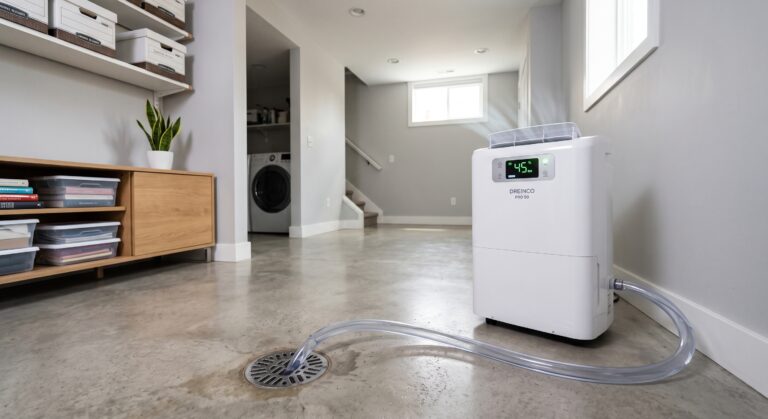
They do different jobs. A dehumidifier removes moisture from the air and prevents mold from growing. An air purifier removes spores and particles already in the air. If you have a mold problem, a dehumidifier (and fixing water sources) comes first. A purifier is a useful addition, especially for people with allergies.
Frequently asked questions
Do air purifiers kill mold?
Most don’t kill mold; true HEPA purifiers trap airborne spores in the filter. They don’t affect mold growing on surfaces.
Will an air purifier get rid of a musty smell?
A purifier with an activated carbon filter can reduce musty odors, but the smell will return until the mold source is removed.
Should I run an air purifier during mold cleanup?
It can help capture spores released while cleaning, especially in nearby rooms. It’s not a substitute for protective gear or proper containment.
Are ozone air purifiers safe for mold?
No. Ozone can irritate the lungs and worsen asthma, and at safe levels it isn’t effective against mold. Avoid ozone generators in occupied homes.
Can an air purifier help with mold allergies?
It may help reduce symptoms by lowering airborne spores, especially in the bedroom. If you have ongoing symptoms, talk to a doctor; this is general information, not medical advice.
Sources
- U.S. Environmental Protection Agency (EPA): A Brief Guide to Mold, Moisture, and Your Home
- Centers for Disease Control and Prevention (CDC): Mold
Last reviewed: October 2026. This article is for general information and is not medical, legal or professional advice.