Are Home Mold Test Kits Accurate?
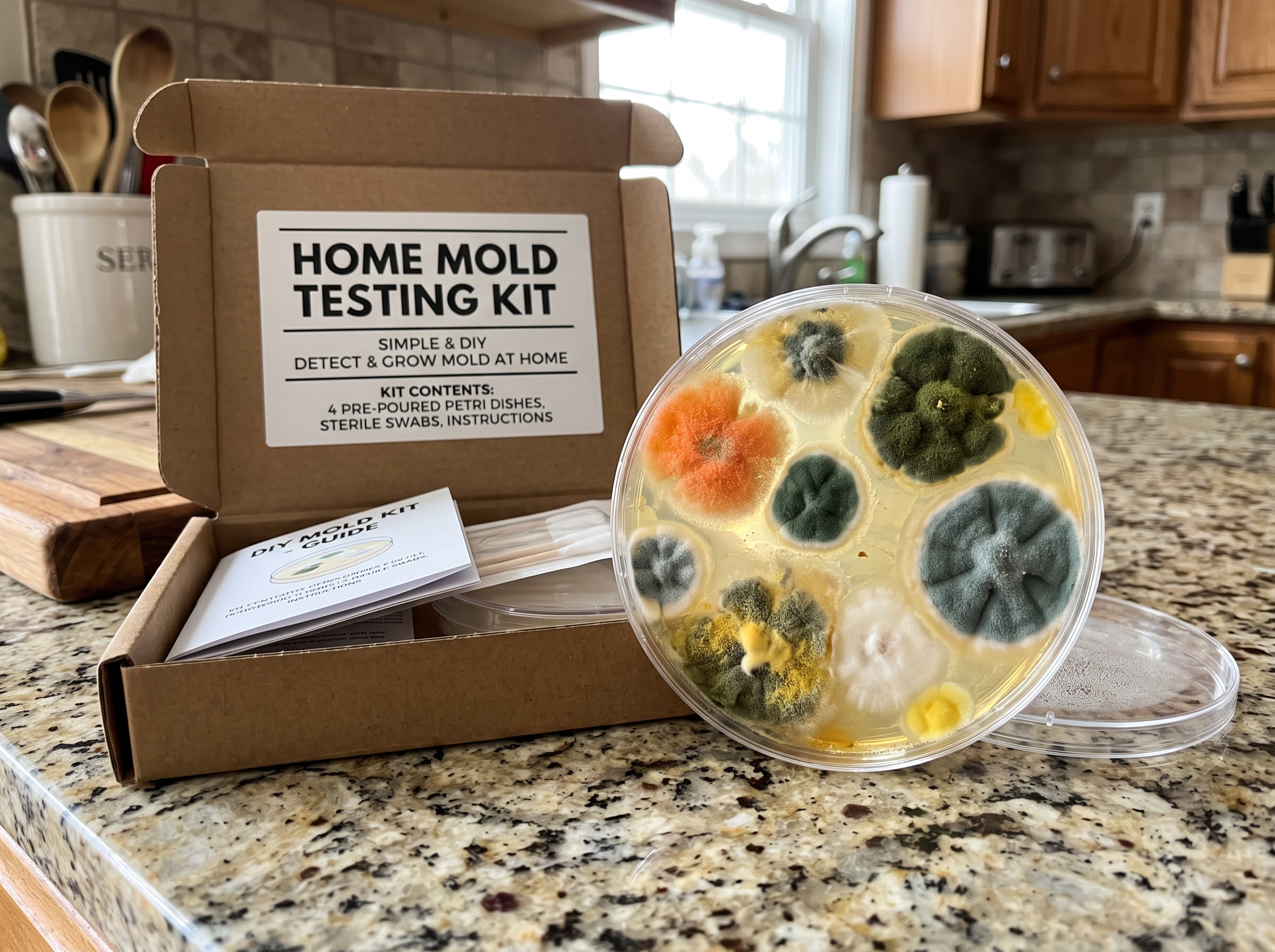
Home mold test kits are cheap, easy to find and promise quick answers. Set out a dish, wait a few days, and see if mold grows. But do they actually tell you whether your home has a mold problem?
Quick answer: most home mold test kits aren’t very useful on their own. The common petri-dish kits almost always grow some mold, because mold spores are naturally present in all indoor and outdoor air, so a “positive” result rarely means much. They can’t tell you how much mold is normal, can’t find hidden mold, and lab analysis usually costs extra. If you can see or smell mold, the EPA says you generally don’t need to test it; just remove it and fix the moisture. If you suspect hidden mold, a professional inspection is far more reliable.
Types of home mold test kits
| Type | How it works | How useful is it? |
|---|---|---|
| Settle plate (petri dish) | Leave an open dish of growth medium out for an hour or so, close it, and wait several days for colonies to grow | Low. Almost always grows something, and doesn’t measure how much mold is in the air |
| Swab or tape-lift kit | Swab or tape a visible spot and mail it to a lab | Moderate. Can identify the type of mold on a visible spot, but you usually don’t need to know the type |
| Air sampling kit (with pump) | A small pump draws a measured amount of air through a cassette sent to a lab | Better, but results are hard to interpret without an outdoor comparison and professional context |
| Dust tests (ERMI-style) | Collect settled dust and send it for DNA analysis of mold types | Gives a snapshot of mold types in dust; its usefulness for individual homes is debated |
| Instant color-change tests | A swab changes color if mold is present | Low. Only confirms there’s mold on something you can already see |
The main problems with DIY kits
- Mold spores are everywhere. Every home has some airborne spores, coming in from outdoors. A dish that grows mold doesn’t mean you have a mold problem.
- No baseline. Professional tests compare indoor air with outdoor air and with other rooms. Most DIY kits don’t, so you can’t tell if levels are high.
- No standard “safe” level. There are no official federal limits for mold spores in homes, so even lab numbers need expert interpretation.
- They can’t find hidden mold. The real question is often “where is it?”, and a dish on a counter can’t tell you that.
- Results vary a lot with air movement, timing, room activity and how the kit is used.
- Lab fees are extra. The kit may be cheap, but identifying the mold often costs $30 to $100 or more per sample.
- They can cause false alarm or false reassurance. Many colonies can lead to panic; few colonies can make you overlook a real hidden problem.
When a home kit might help
A kit isn’t useless in every case. It can play a small role when:
- You want to know whether a visible spot is mold or just dirt (a tape-lift sent to a lab can confirm it)
- You’re curious and understand the results are only a rough indication
- You want a cheap first step before deciding whether to pay for a professional inspection
Even then, the result rarely changes what you should do: if it’s mold, remove it and fix the moisture.
Better ways to check for mold
| Instead of a kit, try… | What it tells you |
|---|---|
| Your eyes (with a flashlight) | Visible mold, stains, peeling paint, water damage |
| Your nose | A musty smell points to active mold, even if hidden |
| A hygrometer | Whether indoor humidity is in the mold-friendly range (above 60%) |
| A moisture meter | Whether walls, wood or floors are damp, a sign of hidden leaks |
| A professional inspection | Where the mold is, how much, what’s causing it, and what to do |
DIY test kit vs. professional inspection
| DIY kit | Professional inspection | |
|---|---|---|
| Cost | About $10 – $50, plus lab fees | About $300 – $800+ |
| Finds hidden mold | No | Often, using moisture meters and thermal cameras |
| Compares indoor vs. outdoor air | Rarely | Yes |
| Finds the moisture source | No | Yes |
| Expert interpretation | No | Yes |
| Written report and recommendations | No | Yes |
| Useful for insurance or home sales | Rarely | Yes |
If you decide to use a kit anyway
- Choose a kit with lab analysis from an accredited lab, not just a dish to look at.
- Test outdoors too, at the same time, to have something to compare with.
- Follow the instructions exactly: exposure time, closed windows, no fans running.
- Don’t panic about a positive result. Some growth is normal.
- Look at the bigger picture: smell, humidity, visible damage and symptoms matter more than the dish.
- Call a professional if results, smells or symptoms suggest a hidden problem.
Frequently asked questions
Do mold test kits from the hardware store work?
They detect that mold spores exist, which is almost always true. They don’t reliably tell you whether you have a mold problem or where it is.
Why did my mold test grow mold everywhere?
Because mold spores are naturally present in all indoor and outdoor air. Growth on a petri dish is expected, even in a healthy home.
Is it worth testing visible mold?
Usually not. The EPA says that if you can see or smell mold, you don’t need to identify the type; just remove it and fix the moisture.
What’s the most accurate way to test for mold?
A professional inspection with moisture readings and air or surface samples analyzed by an accredited lab, compared against outdoor air.
Can I use a kit to check if mold removal worked?
It’s not reliable for that. For larger jobs, independent clearance testing by a professional is the better option.
Sources
- U.S. Environmental Protection Agency (EPA): A Brief Guide to Mold, Moisture, and Your Home
- Centers for Disease Control and Prevention (CDC): Mold
Last reviewed: October 2026. This article is for general information and is not medical, legal or professional advice.