Types of Household Mold: Identification Guide With Photos
You just found a dark patch on the bathroom ceiling, a fuzzy white spot in the basement, or a musty smell you can’t place. The first question is always the same: what kind of mold is this, and should I worry?
Quick answer: most household mold belongs to a handful of common types, including Cladosporium, Penicillium, Aspergillus, Alternaria and, less often, Stachybotrys (the so-called «black mold»). You can’t identify the exact species by eye, and you don’t need to. The CDC and EPA agree that any mold growing indoors should be removed, and the moisture problem behind it fixed, whatever its type or color.
That said, knowing the common types helps you understand what you’re looking at, how serious the moisture problem might be, and whether it’s a job for a sponge or a professional. This guide walks you through each one.
What household mold is and why it grows
Mold is a type of fungus. Its microscopic spores float in the air everywhere, indoors and outdoors, all the time. They’re harmless until they land on a surface that gives them three things:
- Moisture: a leak, condensation, a flood, or indoor humidity that stays above about 60%.
- Food: almost any organic material, such as drywall paper, wood, carpet, cardboard, fabric, dust and even soap scum.
- Time: after water damage, mold can start growing within 24 to 48 hours.
Of the three, moisture is the only one you can realistically control. That’s why every mold problem is really a moisture problem. If you clean mold without fixing the water source, it will come back, usually in the same spot.
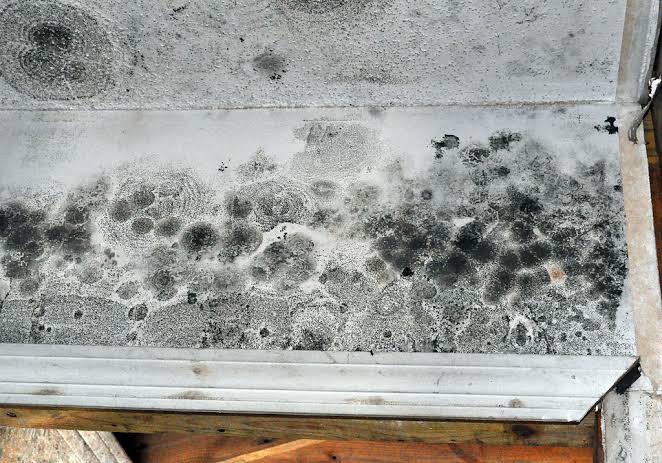
[Foto: primer plano de moho en el techo de un baño con condensación visible]
The most common types of household mold
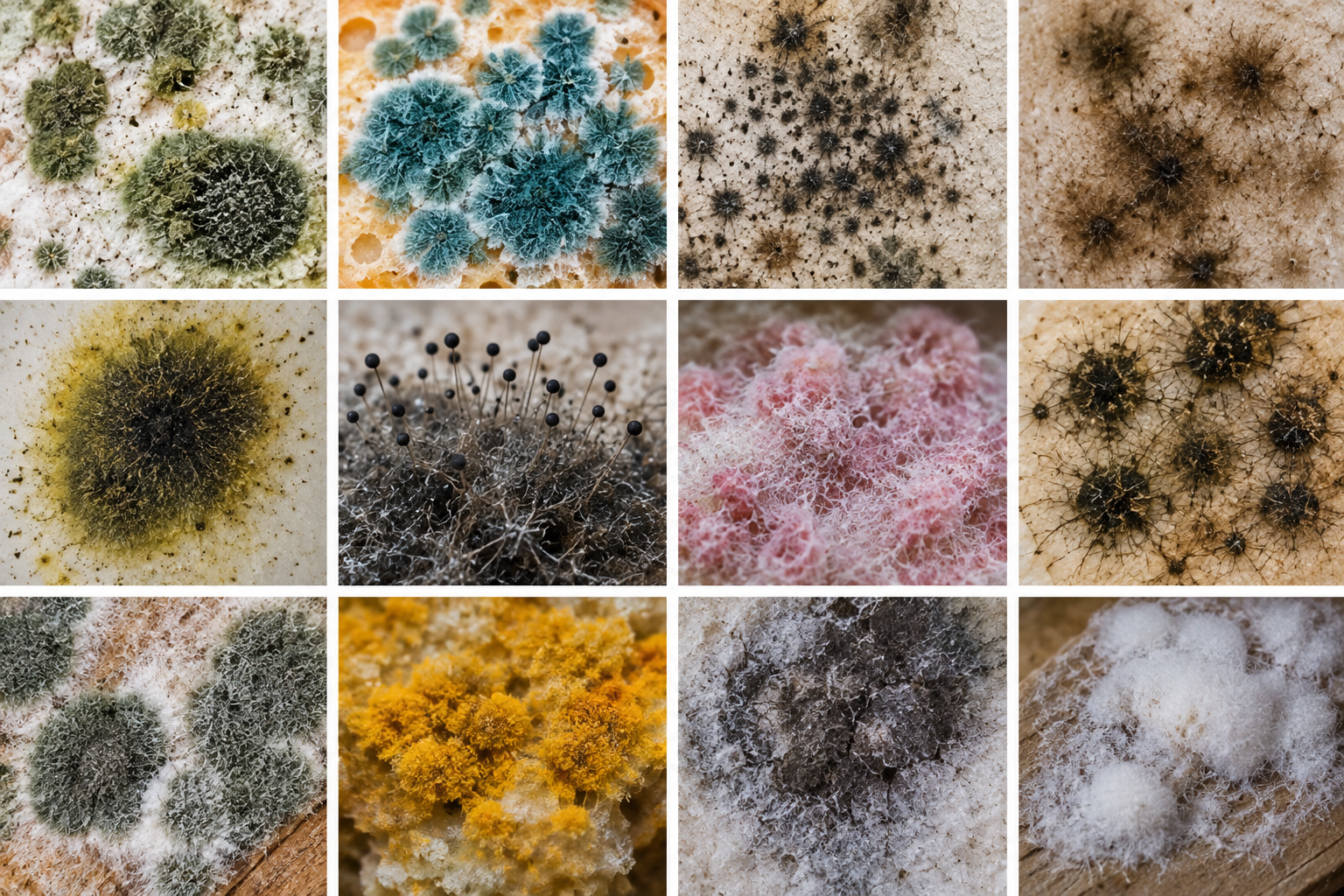
These are the molds you’re most likely to find in a US home. Colors vary with age, surface and light, so use this as a guide, not a diagnosis.
| Mold type | Typical color and texture | Where it grows | What it tells you |
|---|---|---|---|
| Cladosporium | Olive-green to black; velvety or powdery | Window frames, fabrics, wood, HVAC vents, cool surfaces | The most common indoor mold; often condensation-related |
| Penicillium | Blue-green; fuzzy | Water-damaged drywall, carpet, insulation, old food | Spreads fast; common after leaks |
| Aspergillus | Green, yellow, gray or black; powdery | Dust, walls, HVAC systems, stored food | Very common; a concern for people with weak immune systems |
| Alternaria | Dark green to brown-black; velvety with hair-like strands | Showers, tubs, under sinks, window frames | Classic bathroom mold; a common allergen |
| Stachybotrys chartarum | Dark greenish-black; slimy when wet, sooty when dry | Drywall paper, ceiling tiles, wood that stays wet for days | Signals long-term water damage; needs a real fix |
| Chaetomium | White or gray and cottony, darkening with age | Water-damaged drywall, baseboards, roof leaks | Strong musty smell; points to a hidden leak |
| Trichoderma | White patches turning green | Damp wood, carpet, wallpaper, HVAC filters | Can damage building materials over time |
| Aureobasidium | Pink, brown or black | Caulk, grout, painted surfaces, window frames | Common on damp bathroom and kitchen surfaces |
| Mucor | White to gray; fast-growing and fluffy | Near HVAC units, damp carpet, basements | Grows in thick patches where condensation builds up |
| Fusarium | Pink, white or reddish | Water-damaged carpet, wallpaper, fabrics | Often follows flooding or chronic leaks |
[Fotos: una imagen por tipo, mismo tamaño, con pie de foto indicando superficie y estancia]
About «black mold»
«Black mold» usually refers to Stachybotrys chartarum. It gets a lot of scary headlines, but two facts matter more than the name. First, many other common molds are also black (Cladosporium and Alternaria, for example), so color alone can’t tell you it’s Stachybotrys. Second, according to the CDC, black mold is not uniquely «toxic» in the way it’s often described: the health risk depends more on how much mold there is and how sensitive you are than on its color. What Stachybotrys does tell you is that a material has been wet for a long time, which needs fixing either way.
How to identify mold by color, location and smell
You can’t name the species without a lab, but three clues tell you a lot: what it looks like, where it is, and how it smells.
By color
- Black or dark green: Cladosporium, Alternaria, Aspergillus or, if the material has been wet for a long time, Stachybotrys. Most common in bathrooms, around windows and on water-damaged drywall.
- White: often early-stage mold (Mucor, Chaetomium, Trichoderma) on basement joists, crawl spaces and attics. Before assuming it’s mold, rule out efflorescence (see below).
- Green or blue-green: Penicillium and Aspergillus. Common on drywall, fabrics and anything that got wet in a leak.
- Pink or orange: in showers it’s usually Serratia marcescens, a bacterium rather than a mold. On caulk or painted surfaces it may be Aureobasidium or Fusarium.
- Yellow: Aspergillus species or slime molds, usually on wood or wet organic material.
By location
| Where you found it | Likely cause | Most common culprits |
|---|---|---|
| Bathroom ceiling or grout | Steam and poor ventilation | Alternaria, Cladosporium, Aureobasidium |
| Window sills and frames | Winter condensation | Cladosporium, Aureobasidium |
| Basement walls and joists | High humidity, groundwater | Mucor, Penicillium, Trichoderma |
| Attic sheathing | Poor ventilation, roof leak | Cladosporium, Penicillium |
| Under the kitchen sink | Slow plumbing leak | Penicillium, Aspergillus, Stachybotrys |
| Behind drywall or baseboards | Hidden leak or flood damage | Stachybotrys, Chaetomium |
| Carpet and fabrics | Spills, flooding, damp floors | Fusarium, Penicillium |
By smell
Mold releases gases (called microbial volatile organic compounds, or MVOCs) that produce the classic musty, earthy smell, a bit like wet socks or old books. If a room smells musty but you can’t see anything, mold may be growing behind walls, under flooring or inside HVAC ducts. A strong smell with nothing visible is one of the most reliable signs of a hidden moisture problem.
Mold look-alikes: what else could it be?
Not every stain is mold. Before you buy products or call a contractor, rule out these common look-alikes.
| Look-alike | How it looks | Quick test |
|---|---|---|
| Mildew | Flat, powdery, white or gray, on surfaces like shower tiles | Wipes off easily with a household cleaner; mold tends to be fuzzy or slimy and stains the surface |
| Efflorescence | White, crystalline, chalky deposits on concrete or brick | Spray with water: efflorescence dissolves; mold doesn’t. It also crumbles into powder when rubbed |
| Soot | Black, greasy smudges near candles, fireplaces or vents | Smears when touched, has no smell, and appears in lines or patterns near heat sources |
| Dirt and dust | Gray or brown film, often on high-traffic surfaces | Lightly dab with diluted bleach (1 part bleach to 10 parts water): dirt stays dark; mold usually lightens within a couple of minutes |
| Water stains | Yellow or brown rings on ceilings | Flat and dry to the touch with no texture, but still a sign of a leak worth checking |
Mildew is technically an early, surface-level form of mold, so treat it the same way: clean it and reduce the humidity that caused it.
[Foto comparativa: eflorescencia vs. moho blanco en pared de sótano]
Is household mold dangerous?
For most healthy people, small amounts of household mold cause mild or no symptoms. But mold can affect some people more than others, and large or long-running growth is a problem for everyone.
Common reactions include a stuffy nose, sneezing, coughing, itchy eyes, a sore throat or skin irritation. People who should be more careful include:
- People with allergies or asthma, whose symptoms can get worse around mold.
- People with weakened immune systems (for example, during cancer treatment or after a transplant), who are at higher risk of infections from molds like Aspergillus.
- Babies, young children and older adults.
- People with chronic lung conditions.
If you or someone in your home has symptoms that improve when you’re away from the house, or you’re in a higher-risk group, talk to a doctor. This guide is general information and not medical advice.
How to confirm what you have
In most cases, you don’t need to test. If you can see or smell mold, the EPA’s position is simple: remove it and fix the moisture. Testing is worth it in a few situations:
- You smell mold but can’t find it, and suspect it’s hidden in walls or ducts.
- You’re buying or selling a home and need documentation.
- Someone in the home has health concerns and a doctor wants to know more.
- You want proof that a professional cleanup actually worked (post-remediation testing).
Your options are DIY test kits (cheap, but hard to interpret and prone to misleading results) or a professional mold inspection, which typically includes moisture readings, a visual inspection and air or surface samples sent to a lab.
Can you remove it yourself, or do you need a pro?
The type of mold matters less than how much there is and what caused it. The EPA uses a simple rule of thumb: if the moldy area is smaller than about 10 square feet (roughly a 3 ft × 3 ft patch), most homeowners can clean it themselves.
| Situation | DIY is usually fine | Call a professional |
|---|---|---|
| Size | Under ~10 sq ft | Over ~10 sq ft or spreading |
| Surface | Hard, non-porous (tile, glass, sealed wood) | Porous materials soaked through (drywall, insulation, carpet) |
| Cause | Obvious and fixed (steam, a spill) | Unknown, hidden, or ongoing leak |
| Water source | Clean water | Sewage or floodwater |
| Location | Visible surfaces | Inside walls, HVAC ducts, crawl spaces |
| People at home | Healthy adults | Anyone with asthma, allergies or a weak immune system |
If you clean it yourself, wear an N95 mask, gloves and goggles, ventilate the room, and throw away porous materials that can’t be fully cleaned. Our step-by-step guide covers the process in detail.
How to stop mold from coming back
Identifying mold is only useful if you stop the cause. The basics:
- Keep indoor humidity between 30% and 50%. A cheap hygrometer tells you where you stand.
- Run a dehumidifier in basements and crawl spaces, especially in summer.
- Use bathroom and kitchen exhaust fans during and for 20–30 minutes after showers and cooking.
- Fix leaks in roofs, pipes and windows as soon as you spot them.
- Dry anything that gets wet within 24 to 48 hours.
- Keep gutters clean and make sure the ground slopes away from your foundation.
Frequently asked questions
What is the most common type of mold in homes?
Cladosporium is the most common mold found indoors, followed by Penicillium and Aspergillus. They’re common because their spores are everywhere outdoors and easily drift inside.
Can I tell what type of mold I have just by looking at it?
Not reliably. Color and texture give you clues, but many types look alike and change color as they grow. Only a lab test can confirm the species, and for cleanup purposes you usually don’t need to know it.
Is white mold less dangerous than black mold?
No. Color isn’t a measure of danger. White mold in a basement can come from the same moisture problem, and bother the same people, as black mold on a bathroom wall. Treat all indoor mold the same way.
Is all black mold toxic?
No. Several common molds are black, and even Stachybotrys isn’t uniquely «toxic» in the way it’s often described. What matters most is how much mold there is and who’s exposed to it.
Why does mold keep coming back in the same spot?
Because the moisture source hasn’t been fixed. Cleaning removes the visible growth, but if the surface stays damp from condensation, a leak or high humidity, spores will settle and grow again.
Does mold die in winter?
Mold goes dormant in cold, dry conditions but doesn’t die. It becomes active again as soon as moisture returns, which is why window condensation in winter so often leads to mold.